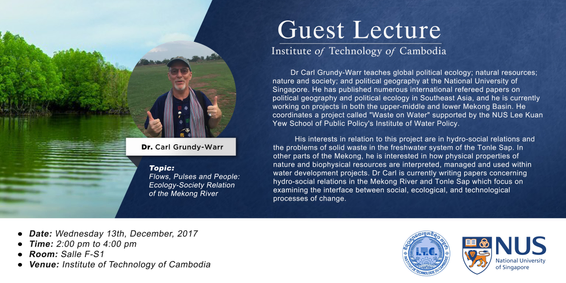
The upcoming event on 13 December 2017 will be a guest lecture from National University of Singapore, Dr. Carl Grundy-Warr will give a talk on the topic “Flows, Pulses and People: Eclology-Society Relation of the Mekong River”. This special lecture is open for all to attend especially for those who interest on Eclology-Society Relation in the fresh water ecosystem. For more information, please see the attached banner.
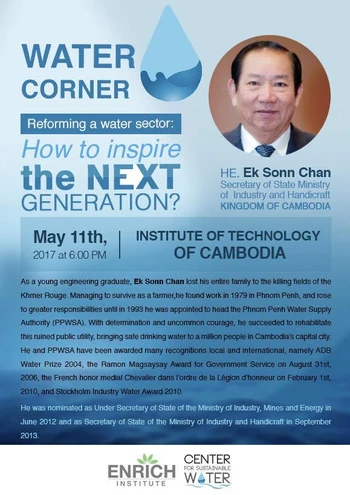
On 11 May 2017, Cambodian young professionals from Department of Rural Engineering at Institute of Technology of Cambodia helped in organizing a forum on “Water Corner” under the topic of Reforming a Water Sector: How to Inspire the Next Generation? In this special event, H.E. Ek Sonn Chan, Secretary of State, Ministry of Industry and Handicraft of Cambodia was invited to be the honorable quest speaker. Mr. Ek Sonn Chan had become the director of Phnom Penh Water Supply Authority (PPWSA) from 1993 to 2011. He shared to the participants about his experience and lesson learnt including challenges and opportunity during his works for PPWSA. With his leadership principle and strong commitment, he has made significant improvement in terms of administrative and technical works in PPWSA. Since then, PPWSA successfully rehabilitated the malfunction water supply system by increasing the distribution network to deliver safe water to million people in Phnom Penh city and water loss was reduced from 72% of the total water production in 1993 to only about 6% in 2011. From his effort with good achievement, he and PPWSA have been awarded with many regional and international recognitions. Furthermore, H.E. Ek Sonn Chan also highlighted potential working opportunities in water sector and encouraged the students to have strong commitment with working professionally. He also expressed his concern about society and reminded the young generation to start considering and changing for better living society. The pictures below show some activities during Water Corner forum.
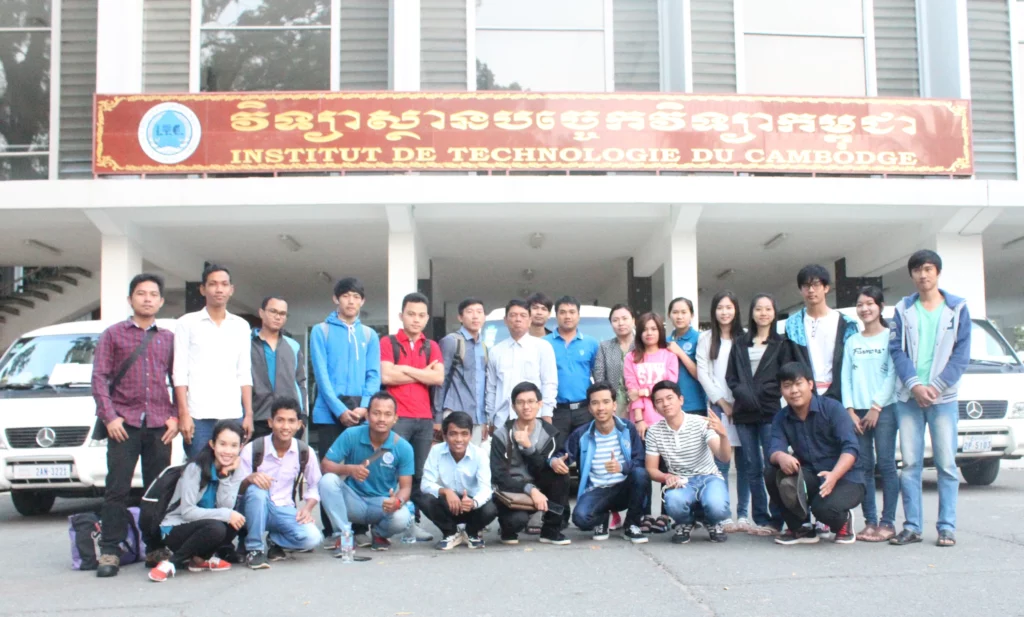
Through the cooperation between Institute of Technology of Cambodia (ITC) and Asian Development Bank (ADB), the 5th year students from Department of Rural Engineering who receive scholarship support from ADB need to accomplish an educational field trip in order to learn on the actual engineering practices as well as management in the field specifically on water resources and rural infrastructure.
This year, Department of Rural Engineering of ITC has organized an educational field trip for the 5th year students under ADB’s scholarship program to Siem Reap province. This field trip aimed to help the students to build up their knowledge and know-how on water management and hydraulic structures development at the field within Angkor’s area under authorization of APSARA National Authority (APSARA). In the spirit of good cooperation so far, ITC has formally requested to APSARA for permitting a group of students and lectures to fulfill this field trip in Angkor’s area. Accordingly, APSARA has approved and requested to submit a report after completion. Moreover, APSARA has assigned technical staffs from Department of Water Management to facilitate and guide the students to learn about their projects at the specific sites in Angkor’s area.
The educational field trip has been carried out for 4 days from 13th to 16th February, 2017. This field trip was led by three lecturers from Department of Rural Engineering of ITC (Dr. Chhuon Kong, Dr. Hak Danet, Mr. Kem Chom) and participated by 29 students from Department of Rural Engineering, who receive ADB’s scholarship support.
The specific places to visit in Angkor’s area were: Department of Water Management of APSARA National Authority, Sras Srang Reservoir, Krang Kroch trees plantation field, Ta Som check-structure, North Baray (Jayatataka), Neak Pean ancient water filtration (middle of Nort Baray), Phreah Khan Temple drainage system, Angkor Thom’s moat, Trapeang Kchhorng Sedimentation basin, Sedimentation trapping channel connected to Angkor Wat’s moat, West Baray (Suryatataka) and hydraulic structures of Chaw Srei Vibol Temple (North and South moat, connection channel, check structure). Below are some photos of activity taken during the field trip.
This 4-day educational field trip was completed with the fruitful outcomes. It provided good lesson learnt particularly for the students to understand about water management and hydraulic structure including the ancient and present hydraulic network in Angkor’s area. Notably, water management in Angkor’s area is significantly challenged since there are 4 main purposes to be concerned on:(1)Supply and maintain water in the moats systems in Angkor’s area; (2)Store and release the water to avoid flooding in Siem Reap during wet season; (3)Store and release water for irrigation system and other uses; (4)Clear and clean the water before supplying to the moat system in Angkor’s area; (5)Explore the ancient hydraulic system to rehabilitate with maintaining cultural landscape, preserving all authenticity and safeguarding the integrity for sustainable development in Angkor’s area. Impressively, on the third day of field trip, the students got interviewed by media staffs from department of communication of APSARA about their impression and activity during the field trip. The news of this field trip and the interview was published in the website of Apsara National Authority. Furthermore, this educational field trip helps to further strengthen relationship and closer cooperation not only between technical staffs and lecturers/students but also between institutions.
On 21 January 2017, Department of Rural Engineering organized the 1st Rural Engineering Student Conference. The objective of this event was to encourage the engineering students become involve in profession that is crucial to ensuring the sustainable development in Cambodia through research. This event helped the students gain more knowledge and experience that will be valuable for their future studies and careers. Moreover, it served as a platform where the students can express their opinion through the critical point of view in the engineering problem related to environment, water resources and rural infrastructures. The theme of this year conference is “Research for Sustainable Water related and Rural Infrastructure Development in Cambodia“. The venue of the this event was at Salle Conference I in Institute of Technology of Cambodia (ITC).
The event began with registration from 7:30 am to 8:00 am. Then, the ceremony started with Khmer National Anthem. After that, the Welcome Remarks was addressed by Dr. Ly Sarann, Head of Department of Rural Engineering and the Opening Speech in regard to the research encouragement which was addressed by Dr. Hul Seingheng, Director of Research and Development, Institute of Technology of Cambodia.
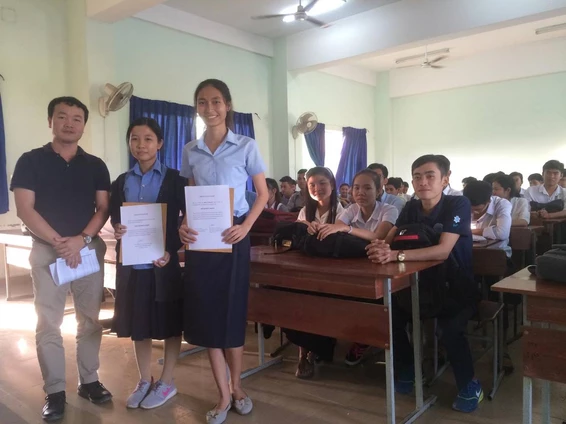
There were two best presenters selected from two different sessions. One was selected from morning session on “Water Resources” and another one was selected from afternoon session on “Environment and Infrastructure“. Each best presenter received the best presentation award from Dr. Heng Sokchhay. The certificate of contribution was given to all presenters and their teamwork before closing ceremony which was addressed by Dr. Oeurng Chantha, Deputy Head Department of Rural Engineering. The Department of Rural Engineering committed to organize this Rural Engineering Student Conference every year. We will try to improve this event and we are seeking and welcome for the sponsors to support our preparation in the next year event.
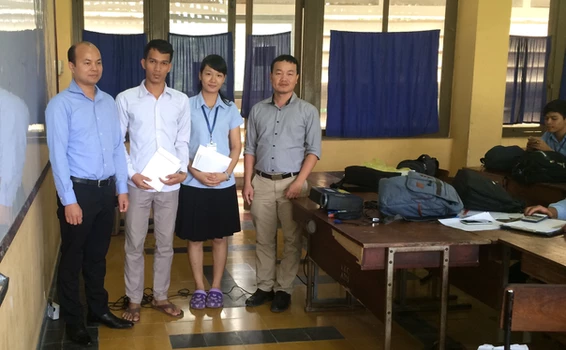
Miss LIM SOKNETH (middle) obtained the HENG SOKCHHAY AWARD (outstanding student award) and Miss HENG SOUSEANG (right) obtained the HEM RAMRAV AWARD (outstanding female student award). Both of them are currently the third year student in the Department of Rural Engineering. The awards were delivered by Dr. Heng Sokchhay (left) on December 27, 2016. Congratulation!
Certificate of Award: This is to certify that LIM SOKNETH, date of birth: 07 July 1996, was selected as a recipient of the HENG SOKCHHAY AWARD. The award equivalent to USD100.00 is generously provided by Dr. Heng Sokchhay. Please note that this award is being offered to outstanding students who enter the Department of Rural Engineering, Institute of Technology of Cambodia.
Certificate of Award: This is to certify that HENG SOUSEANG, date of birth: 16 September 1997, was selected as a recipient of the HEM RAMRAV AWARD. The award equivalent to USD100.00 is generously provided by Dr. Hem Ramrav. Please note that this award is being offered to outstanding female students who enter the Department of Rural Engineering, Institute of Technology of Cambodia.
Mr. CHHIM Sochittra, Mr. HOK Panha and Mr. SENG Theara are fresh graduates of the Department of Rural Engineering (GRU), Institute of Technology of Cambodia (ITC). They recently finished their study from ITC-GRU in July 2016. Mr. CHHIM Sochittra and Mr. SENG Theara made an oral presentation, and Mr. HOK Panha made a poster presentation in the International Conference on Water Security and Climate Change: Challenges and Opportunities in Asia, 29 November–01 December 2016, Asian Institute of Technology, Thailand. The conference supported all their expenses including air ticket to participate in this scientific meeting. Their presentation was about their research results obtained during the study at ITC-GRU. Three lecturers of the Department, Dr. LY Sarann, Mr. SOY Ty and Dr. HENG Sokchhay, also attended this conference.
Presented in the Technical Session: Stakeholder Engagement and Institution Building for Water Security Enhancement, the title of Mr. CHHIM Sochittra’s research paper is “Analysis of Public Perceptions on Urban Flood in Phnom Penh, Cambodia”; co-authors of this article are Dr. HENG Sokchhay, Dr. LY Sarann, and Mr. KRUY Phanith, from ITC-GRU. Regarding Mr. HOK Panha, the title of his research paper is “Estimation of Water Availability in Rivers of Stung Sreng Basin, Cambodia, Using HEC-HMS”; co-authors of this article are Dr. OEURNG Chantha and Dr. HENG Sokchhay, from ITC-GRU. Mr. SENG Theara presented in the Technical Session: Water Economics and the title of his research paper is “Feasibility Study of a Micro-hydropower Project Based on Economic Analysis: a Case Study of a Remote Area in Cambodia”; co-authors of this article are Dr. LY Sarann and Dr. HENG Sokchhay, from ITC-GRU. It should be noted that the course: Water Resources Economics was just introduced in the curriculum of Engineering’s Program of GRU. The abstract of each paper is shown below.
Heng, S., Ly, S., Chhem, S., Kruy, S., 2016. Analysis of public perception on urban flood in Phnom Penh, Cambodia. The International Conference on Water Security and Climate Change: Challenges and Opportunities in Asia, 29 November–1 December 2016, Asian Institute of Technology, Bangkok, Thailand.
Abstract: A remarkable population and economic growth has been seen in Phnom Penh, a center of commerce, tourism and residence. Urbanization in this capital city of Cambodia, changes of land cover from pervious to impervious areas, and the climate change phenomenon introducing a more intense rainfall within a short time, have led to frequent flooding during the rainy season. Human activities might be a main contributing factor to urban floods in this area. To propose a sustainable measure for such water-related hazard, understanding on public perception is one among various important issues to be considered. This study is aimed at analyzing public perceptions on urban flood in Phnom Penh. A questionnaire survey on 100 samples was conducted within four dense districts of the city. Key findings of the survey are: (1) flood depth of 0.15-0.30 m and flood duration of less than 1 h was very common since it is a rainfall-flood phenomenon, no overflow from rivers; (2) the impacts were greatly on small businesses and health of citizens; (3) most of the people did nothing when there are flood occurrences because flood water does not flow into their house; (4) garbage in the drainage system reduced the flood flow capacity; and (5) education on water engineering and effective garbage management were recommended by citizens to solve flood problems on a long term basis. These results might urge the government to take immediate actions on this extreme event. They also provide essential information for proposing a sustainable flood management strategy.
Hok, P., Oeurng, C., Heng, S., 2016. Estimation of water availability in rivers of Stung Sreng Basin, Cambodia, using HEC-HMS. The International Conference on Water Security and Climate Change: Challenges and Opportunities in Asia, 29 November–1 December 2016, Asian Institute of Technology, Bangkok, Thailand.
Abstract: River system of the Tonle Sap Lake plays an important role in ensuring a long-term economic growth in Cambodia, meaning that water supply for domestic consumption, agriculture and environment, etc. must be sufficient. Stung Sreng is one among 11 main rivers of the lake system and it comprises of four ungauged tributaries: Stung Srang, Stung Sreng, Stung Tanat and Stung Phlang. Stung Sreng has the biggest drainage area and lies in the world tourism site of Siem Reap province. A remarkable increase in number of tourists of over two million visiting Siem Reap in 2015 and the government’s target of exporting one million ton of rice per annum have posed a great concern on water security. Water from Stung Sreng might be used for tourism sector only. Therefore, analysis of water availability from each tributary is absolutely indispensable. HEC-HMS was applied to calibrate and validate daily streamflow at a station where observed data is available. Indicated by three error indices, accuracy of the model prediction was concluded as satisfactory. The successfully calibrated HEC-HMS model was then employed to estimate water availability. The annual streamflow of Stung Srang, Stung Sreng and Stung Tanat River was estimated at 419, 686 and 230 MCM, respectively. The total yield from the whole basin is about 1572 MCM per year. The available water of 686 MCM/year from only Stung Sreng will be sufficient for tourism sector in Siem Reap, whereas the remaining amount of 886 MCM/year can be used for agriculture and other purposes.
Seng, T., Ly, S., Heng, S., 2016. Feasibility study of a micro-hydropower project based on economic analysis: a case study of a remote area in Cambodia. The International Conference on Water Security and Climate Change: Challenges and Opportunities in Asia, 29 November–1 December 2016, Asian Institute of Technology, Bangkok, Thailand.
Abstract: As a developing country, Cambodia is requiring a lot of energy to sustain its development. In this context, the Royal Government of Cambodia considers hydropower as a priority sector due to a favourable condition of its natural resources. Since the national grids are unable to link the remote areas and large scale projects commonly introduce high impacts, a micro-hydropower scheme is preferable for rural electrification. This paper aims to study, based on economic analysis, the feasibility of O Katieng micro-hydropower project located in a remote area of Cambodia. Two key materials required for the design of micro-hydropower are topography and long term streamflow information. SWAT model was used to estimate streamflow because of the absence of observed data in the study area. From the flow duration curve, three alternatives of design discharge (2.483, 1.470 and 0.746 m3/s) were selected for proposing the hydropower development scheme and conducting economic optimization. The preliminary results suggest an installed capacity of each alternative as 269 kW, 159 kW, and 79 kW. The corresponding unit production cost of USD 9.32, 11.02 and 15.79 Cent/kWh are considered as feasible comparing to the current average electricity price in Cambodia (approximately USD 20 Cent/kWh). Overall, the development scheme with a designed discharge of 2.483 m3/s was recommended because it generates the highest amount of energy (1.54 GWh/year) with the lowest production cost.
From Institute of Technology of Cambodia (ITC), Department of Rural Engineering (GRU), Dr. LY Sarann, Dr. HENG Sokchhay, Mr. LUN Sambo and Mr. SOK Ty attended the Second Group Workshop of Urban Water Program at Kasetsart University, Bangkok, Thailand, 26-27 October 2016. This is a workshop activity of Working Group 1 of the project: Establishment of Asian Model for Research and Education on Urban Water Resource Management. Our key activities are:
(1) Presentation of research progress
On 26 Oct. 2016 (Day 1), four main researchers of WG1 (Water Resource) of Cambodian Team presented their research progress. Dr. LY Sarann presented about “Simulation of inundation map in Phnom Penh: a review on modeling approaches.” Dr. HENG Sokchhay presented about “Analysis of public perception on urban flood in Phnom Penh, Cambodia.” Mr. LUN Sambo presented about “Assessment of the drainage improvement master plan on urban flood situation in Phnom Penh.”, and Mr. SOK Ty presented about “Planning on installation of new rain gauges to improve urban flood modeling in Phnom Penh.”
(2) Discussion on future activity plan
On 26 Oct. 2016 (Day 1) after the presentation of research progress, the research team had a meeting to discuss future activity plan. We agreed (i) to install two rain gauges in Phnom Penh with a purpose to improve the model predictive accuracy, (ii) continue to improve the model simulation of urban flood situation by comparing NILIM and Flo-2D model, and (iii) to prepare some papers for publishing in international journals.
(3) Study of flood management in Bangkok
On 26 Oct. 2016 (Day 1), Dr. Winai Liengcharernsit from Kasetsart University gave a lecture on “Flood protection system in Bangkok.” On 27 Oct. 2016 (Day 2), the team visited the Flood Management Center of Bangkok Metropolitan in the morning. Mr. Sunsern Rueangrit, Chief of Flood Control Center, presented the organization structure of the center, scope of work of the center and existing flood management system of Bangkok. In the afternoon, the team visited one among many pumping stations, an infrastructure for flood protection in Bangkok.
The research team has showed their research progress and will enhance research results by installing two new rainfall stations in Phnom Penh. Two rain gauges were purchased and brought to ITC, Cambodia. Installation of the rain gauges will be finished before the coming of next rainy season. The team will also disseminate research results by publishing in international journals. The Cambodian team will prepare two journal papers entitled “Public perception on urban flood in developing countries: a case of Phnom Penh, Cambodia” and “Analysis of urban flood management in developing countries: a case of Phnom Penh, Cambodia”. Expected journals are Journal of Flood Risk Management and ASEAN Engineering Journal Part C.
The research team of Cambodia learned some experiences from Bangkok regarding flood management in the city. Existing flood countermeasures in the Bangkok Metropolitan include polder, dike, tunnel, pump, diversion channel, retention storage, flood retaining wall, flood forecasting/warning, weather observation (radar and telemetering stations), maintenance of river/channel,
Topic of the Student Research Competition 2016, Samdech Techo Hun Sen’s Research Prize, is “Road Traffic in Cambodia”. What are the main road traffic issues facing Cambodia today? And, how can we solve them? It is open to all undergraduate students currently studying at universities in Cambodia. The candidates are required to form a team which has at most three members, including both genders. The competition is divided into three stages: concept note, proposal and full paper.
From Department of Rural Engineering (GRU), Institute of Technology of Cambodia (ITC), there are five teams submitted a concept not for the competition. Four teams passed the concept note stage. On 27 September 2016, the four teams submitted their proposal for the competition in the semi-final stage (proposal stage). As a result released on 21 October 2016, two teams among the four passed the semi-final stage and are permitted to proceed to the final stage competition (full paper stage). One team is No. 1 and another is No. 7. It should be remarked that there are 30 teams participated in the semi-final competition and in total 12 teams were selected. Topics of the two successful teams from GRU-ITC are:
1. Research topic: Proposing a Water Bus System to Reduce Traffic Congestion in Phnom Penh, the Capital of Cambodia (No. 1)
Research objective: The main purpose of the proposed research is to alleviate traffic congestion along Preah Norodom Boulevard and National Road No. 5 by introducing a water bus system between Takmao Market and Prek Phnov Bridge (Bassac-Chaktomuk-Tonle Sap River). We will consider several lines of the water bus: express, local express and regular. Location of piers will be proposed near existing city bus stops, bus terminals, schools, major office areas and shopping centers, so that passengers can be transferred to their destinations around the city.
Students: Mr. Tha Theara, Ms. Tha Pisey, Ms. Sun Sreykeo
Instructor: Dr. Heng Sokchhay
2. Research topic: Assessment of Public Understanding on Traffic Law in Cambodia (No. 7)
Research objective: The purpose of this research is to discover the public understanding of traffic law in Cambodia and about the perceptions and behavior of Phnom Penh’s road user. In this case, we identified the problem of the lack of traffic law understanding and then recognized the method that is effective on and a good practice in consumption vehicles of people in daily routine. After organized, we have to try to promote, explain and educate them about advantages of using traffic law. In addition, this research will provide much better about the formality of driver.
Students: Mr. Heng Bunmanut, Mr. Chum Kimleang, Ms. Na Raksmey
Instructor: Mr. Sok Ty
The deadline for submitting the full paper for the final competition is 2 January 2017, meaning that they have only 70 days to conduct the research and prepare the full paper. At the final stage, only one team will be selected for the research prize of $2000.
On 8th September 2016, Institute of Technology of Cambodia, Department of Rural Engineering (ITC,GRU) signed a Memorandum of Understanding (MoU) with Kuraray Asia Pacific Pte Ltd (KAP) and RLS International Pte Ltd on the Pilot testing with Kuraray Product “Evaluation”.
The MoU between the three parties has been carried out because Kuraray has developed certain Advanced Biological Treatment for Wastewater using Moving Bed Bioreactor with specialty product Polyvinyl Alcohol Hydrogen (PVA Gel, called Kuraray Product). Likewise, RLS has developed certain opportunities in Cambodia that potentially can be developed into feasible project using Kuraray Product, And ITC, as higher education academic institution, provides the space and resources to carry out the test bedding of the Kuraray Product.
Following this MoU, Kuraray Product (Moving Bed Bioreactor with specialty product Polyvinyl Alcohol Hydrogen) was delivered and setting up at laboratory of GRU/ITC on 5th October 2016. The Pilot testing will be started afterward for the new academic year.