



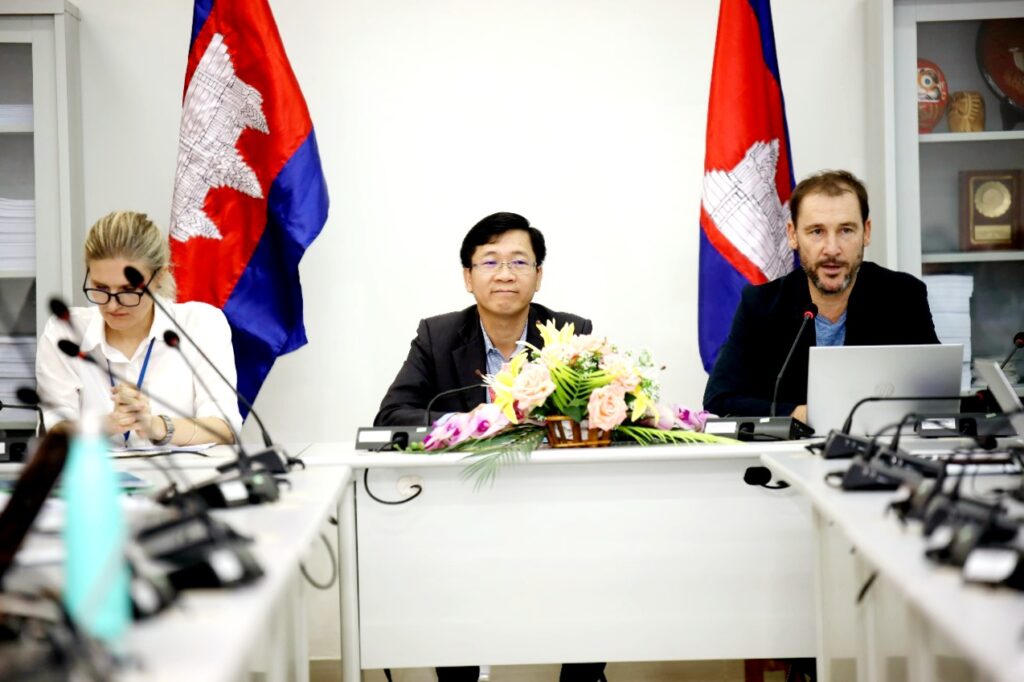
Don’t miss out on the Grand Finale! The grand finale of the Erasmus+ INOWASIA Project is all about igniting a dynamic week of sustainability, innovation, and water transformation. It’s the culmination of years of hard work, dedication, and visionary thinking. Get ready to share electrifying energy, visionary ideas, and impactful collaborations that will redefine the future of water innovation! 13th – 14th November 2023 at the Institute of Technology of Cambodia – សាលាតិចណូ
Faculty of Hydrology and Water Resources Engineering (GRU), Coastal and Wetland Environment Research Laboratory (CWE Lab)
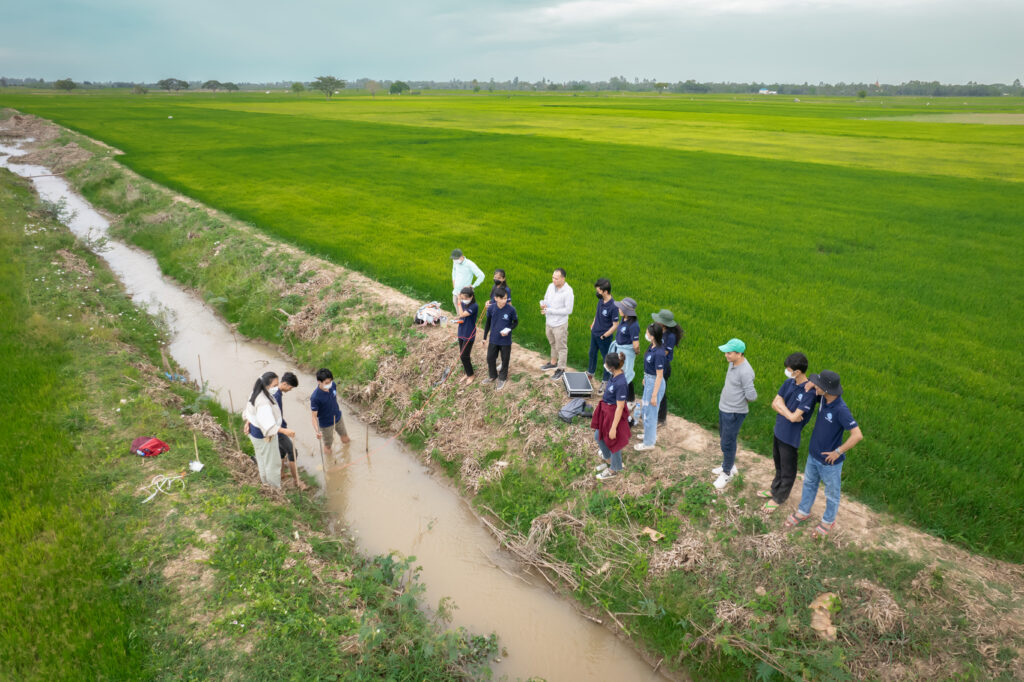
Fieldwork at the Experimental Site of Water Oriented Living Lab. (WOLL) In Prek Sdey Commune, Koh Thom District, Kandal Province, 05th January 2023.
CWE Lab. of the Institute of Technology of Cambodia (ITC) is implementing the collaborative project called COSTEA on the “Understanding and Managing the Cambodian Floodplains: The Preks of Kandal Province” with the Institut de recherche pour le développement (IRD) funded by the Agence Française de Développement (AFD). And through the INOWASIA project “Development of innovative multilevel formation programs for the new water leading professionals in South East Asia”, ITC is working to improve the curriculum, building up the teaching capacity, get staff and student mobility, and equipment for living lab. Particularly, the Faculty of Hydrology and Water Resources Engineering (GRU) implementing the concept of Water Oriented Living Lab (WOLL), and it uses the CWE Lab. as the model which is co-designed together with IRD and integrated with the field monitoring site of COSTEA project which is called Experimental Site of Water Oriented Living Lab.
With all collaborative effort, GRU conducted this fieldwork at the Experimental Site of WOLL which is aimed to engage more the students in WOLL and to provide them with the opportunity to learn from real situation, monitoring equipment and tools and to conduct the actual practices in complement to the knowledge learned in the classes. Another purpose of this fieldwork is to promote the educational program of Water and Environmental Engineering at ITC. These activities were conducted during the special mission of INOWASIA project coordinator from Spain to Cambodia, Prof. Dr. Ignasi Rodríguez-Roda from University of Girona, and Dr. Antonina Torrens, from Fundació Solidaritat Universitat de Barcelona (FSUB).
Fieldwork at the Experimental Site of Water Oriented Living Lab. (WOLL), Institute of Technology of Cambodia (ITC)
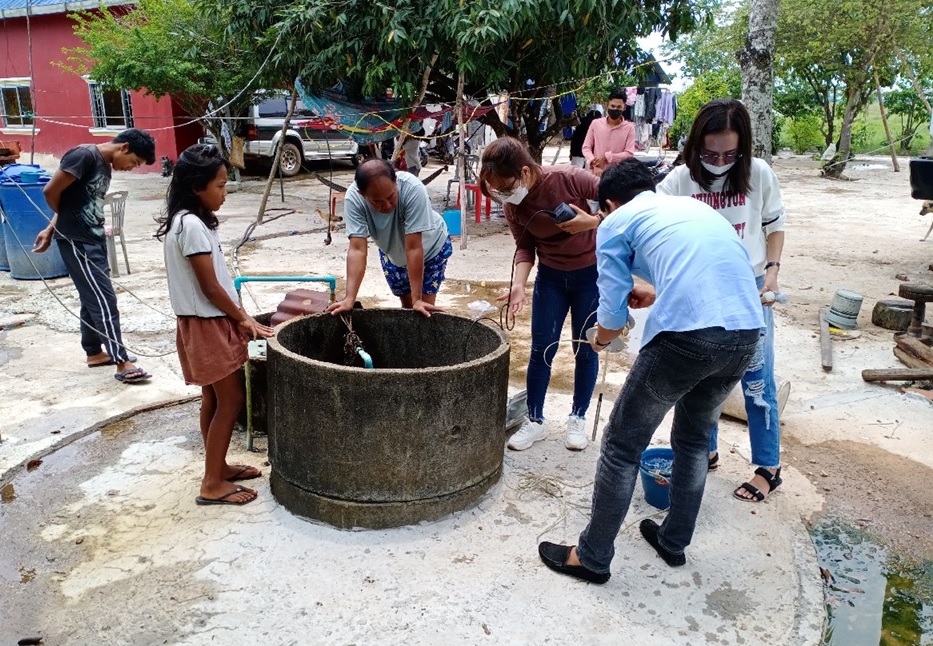
Fieldwork activity (Outdoor education): The idea is to integrate between class work and real experiment on Water and Environmetal Engineering class by performing series of the field practices and measurement including water flow velocity and discharge measurement, In-situ water quality measurement, Groundwater level measurement, Practical work with DGPS and data collection and maintenance the equipment installed in the field. There are 26 students of Water and Environmental Engineering (WEE), 11 Lecturers/researchers (Khmer, French, Spain). We also making video of activity. Let’s wait to see!
Location of Activity In Prek Sdey Commune, Koh Thom District, Kandal Province. The activity is supportes by InowAsia project and COSTEA project of ITC. 05th January 2023,
The activity of the Water Oriented Living Lab. at ITC through the InowAsia project
This research activity is carried out by the research team at the Coastal and Wetland Environment Research Laboratory (CWE) which is used for Water Oriented Living Lab. (WOLL). WOLL is formed under the project InowAsia: Development of innovative multilevel formation programs for the new water leading professionals in South East Asia, which is a project of Erasmus+ under action “Capacity Building for Higher Education”, co-funded by Erasmus+ Programme of the European Union. The research team of CWE consists of 1. Dr. PEN Sytharith, Lecturer-researcher from ITC 2. Dr. DOUNG Ratha, Lecturer-researcher from ITC 3. Dr. Sylvan MASSUEL, Senior researcher from IRD, G-eau lab. 4. Dr. EANG Khyeam, Lecturer-researcher from ITC 5. Dr. CHHUON Kong, Lecturer-researcher from ITC 6. Mr. LUN Sambo, Lecturer-researcher from ITC
Hydrogeochemical Evolution of Groundwater in the Coastal Area of Cambodia
This research is in support of the 4C-Water project “Water Evolution and Vulnerability Under Global Changes in Coastal Catchments of Cambodia” co-funded by JEAI program of IRD.
Groundwater is typically regarded as more reliable and accessible than surface water in Cambodia. As Sihanoukville is undergoing tremendous urbanization, it is estimated to reach water scarcity in this region. Thus, the aim of this study is to investigate groundwater flow, aquifer layers, and their interaction with surface water in order to provide support for the estimation of water availability in this area. The boundary of this study is focused only on the coastal area, which is in the southern part of Sihanoukville, Cambodia. The data input of this study was recorded for three years from 2020 – 2022.
Geological map of the study area with sampling location along the coastal zone of Sihanoukville
Site Description:
Lies between latitudes 10ᵒ 30’ 0” N to 11ᵒ 0’ 0” N and longitudes 103ᵒ 30’ 0” E to 104ᵒ 0’ 0” E, the total area of 1546 km2
Well depth varies from 1.71 to 200 m
Groundwater samples collected in 2020, 2021, and 2022 were 41, 42, and 43, respectively
Geology: sandstone and claystone with laterite layers at certain parts of Sihanoukville and Kbal Chhay region
Altitude ranges between 3 to 860 masl
Sample collection and sample analysis in the field
The present study has proved that the application of hydraulic head in conjunction with the isotopic composition of water under supplementary electrical conductivity enables us to constrain the groundwater flow path, groundwater interaction between aquifers and with surface water, as well as propose the sources of groundwater pollution in the specific area of the coastal region of Sihanoukville. The study found that the hydraulic head varies between 0.5 and 104.6 masl in which groundwater flows toward the sea. In addition, the isotopic compositions of the groundwater are in the range of -7.37 to -3.86 for δ18O, and -47.0 to -23.1 for δ2H. The study found that a few areas located quite near the shoreline with low hydraulic head are suspected to be intruded by seawater. In addition, it was found that the investigated deep wells are all types of sandstone aquifers which are separated from shallow wells by at least one confined layer (aquitard), suggesting that there are at least two types of aquifers (confined and unconfined aquifers) in the study area. In addition, shallow and deep wells with the same geological formation are found to be connected (vertical flow). The evidence from geological formations, hydraulic heads, and stable isotopes supplemented by water electrical conductivity indicates that there is an interaction between the groundwater and surface water in which groundwater feeds the stream.
Stable Isotopes:
o The isotopic values of groundwater samples vary in range -7.37 ‰ – -3.86 ‰ for δ18O, and -47.0 ‰ – -23.1 ‰ for δ2H
o No significant evaporation in most groundwater samples.
–> isolated-from-surface water processes
o Two groundwater samples (F3W31 and F4W05) are below the line
–> possibility of the mixing with seawater or there is an interaction with surface water
Finally, the data obtained from this study can be used as input for further study on the hydrogeological conceptual model of the aquifer. Additionally, it also provides geological information on the existing wells, which will contribute significantly to water resource management tools such as long-term aquifer monitoring networks. The findings of this study play a key role in groundwater quality evaluation as they provide the basic concept of groundwater flow and its interaction, which helps to judge the guilty party that affects the groundwater quality in the study area.
Coastal and Wetland Environment Research Laboratory (CWE) of ITC
Water Oriented Living Lab. under the project InowAsia: Development of innnovative multilevel formation programs for the new water leading professionals in South East Asia